Deep Green

ESG, scope 1-3 emissions, and now EU taxonomy: if compliance regulations are keeping you up at night, you’re not the only one. For your enterprise, the risks of non-compliance range from greenwashing accusations to losing potential investors.
EU taxonomy reporting is already mandatory for many large companies, and from January 2028, the requirements will expand further. For these companies, skipping EU taxonomy reporting - or not providing sufficient evidence to back up alignment claims - can have punitive penalties. For CSOs and CTOs, this means shifting your thinking from bonus sustainability metrics to audit-grade reporting.
Our guide covers exactly how to comply with EU taxonomy when buying HPC colocation from a data centre in the UK, and the methodology you need to go from spreadsheets to audit-ready reporting.
What is the EU taxonomy?
In 2019, the European Green Deal outlined objectives to cut emissions across Europe’s industries, energy sector and transport systems. The EU taxonomy, introduced in 2020, is a classification system that recognises defined ‘environmentally sustainable’ activities. By being taxonomy-aligned, businesses can transparently prove to clients and investors that they are helping the EU meet its climate objectives. Of course, the EU taxonomy isn’t just about meeting objectives and complying with regulations. The real-world impact of taxonomy-aligned business practices is a reduction in emissions that harm our planet.
Why does the EU taxonomy matter for enterprises when buying HPC colocation?
EU taxonomy alignment is the new ‘common language’ for comparing business activities in Europe and assessing their environmental impact. This affects UK companies that do business in the EU, too. Investors and lenders are using the EU taxonomy as a shared definition of what is truly sustainable, instead of relying on vague ESG claims. Consumers are taking notice, and enterprises that don’t align with the EU taxonomy are increasingly hit with greenwashing accusations. Where you host your AI workloads matters; the environmental impact of compute can be huge, so choosing an EU taxonomy-aligned data centre in the UK is crucial when buying HPC colocation.
How to meet EU taxonomy regulations with your compute
To be reported under the EU taxonomy, a ‘relevant economic activity’ must be taxonomy-eligible and taxonomy-aligned. Compute hosting is listed under ‘data processing, hosting and related activities', making it taxonomy-eligible. Next, determine if your HPC colocation is taxonomy-aligned.
What makes an economic activity ‘taxonomy-aligned’?
It must:
Substantially contribute to one of the EU’s environmental objectives
Do no significant harm to the EU’s environmental objectives
Meet minimum safeguards
Meet technical screening criteria
Then, calculate your KPIs: the proportion of your turnover, CapEx, and OpEx that are taxonomy-eligible and taxonomy-aligned. For HPC colocation, this means tracing each KPI back to verifiable operational data and documentation: energy, efficiency, infrastructure investments, and the evidence that supports your calculations.
Prepare your proof
To meet EU taxonomy standards, you can’t just claim numbers. You need a reliable paper trail that proves the environmental impact of your HPC workloads. This includes:
Real-time and periodic performance metrics
A consistent, standards-aligned methodology for calculations
An evidence trail of source documents to back up your calculations
Manual spreadsheet-filling and messy paper trails are disrupting your team’s audit-readiness
Maximilian Weidl, Co-Founder and CEO of compliance-automation software company Clear Decisions, has seen teams struggle with proving their compute complies with regulations. He told us, “Meeting the EU taxonomy standards requires pulling data together from different sources and different teams. Then, that data has to be aggregated, analysed, and compared to the requirements. All of that demands a lot of manual work.”
Without an established system, data lives in too many places, teams interpret requirements differently, and each audit will have you scrambling to keep up. Dashboards are no longer enough, especially when charts don’t have a defensible methodology, or data must be added manually. Just because a dashboard shows you data, you’re not necessarily any closer to solving your compliance headache.
“There’s a big gap between the data that teams already have and the outputs that meet standards for regulators,” Co-Founder and CLO Louisa Cilenti says. EU taxonomy standards require clear, defensible proof of metrics. “Without any assurance behind the numbers, they’re just ink on paper.”
A new kind of dashboard with compliance at its core
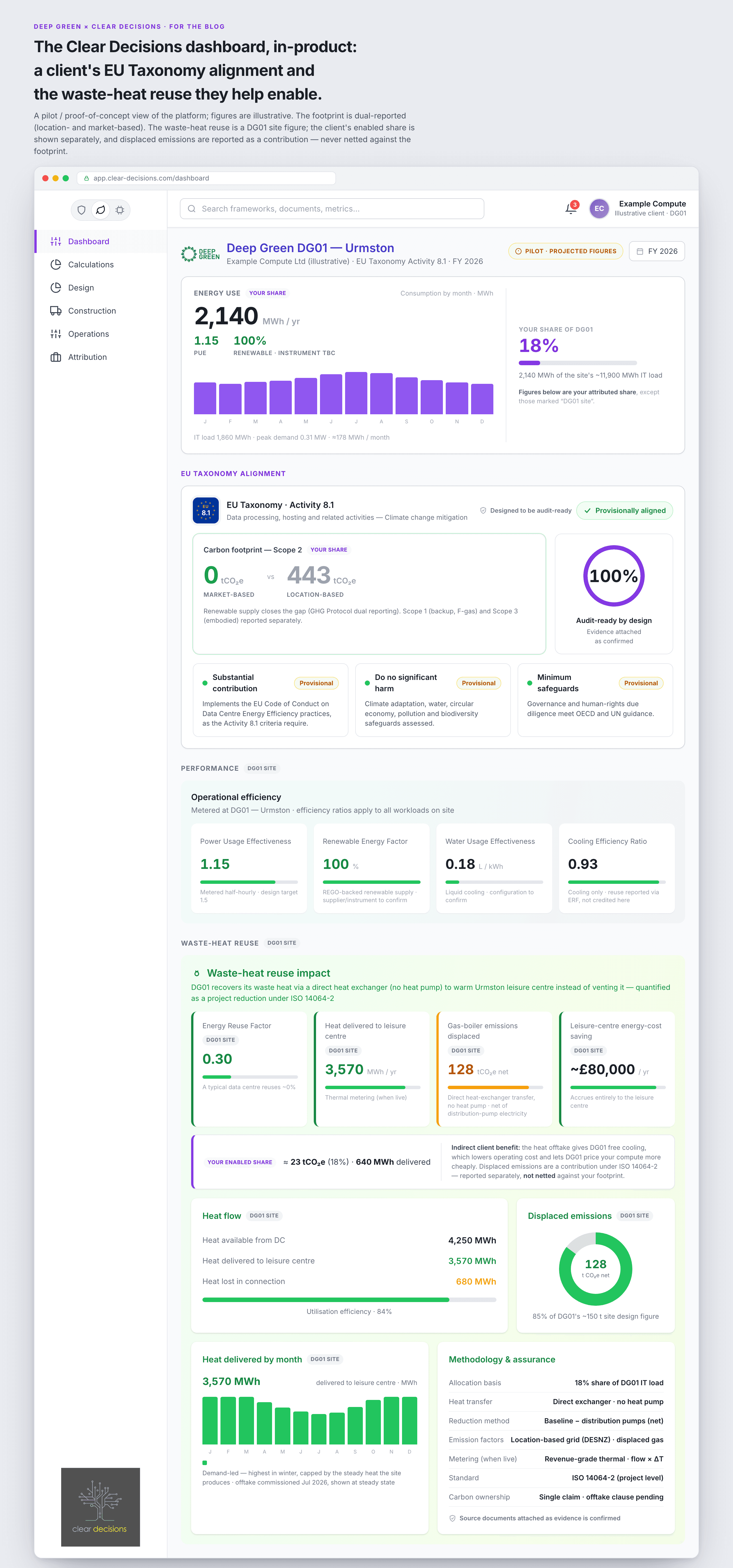
Not all dashboards are built the same. Standard-aligned calculations and evidence attached to every number make a dashboard audit-ready at any moment. When it comes to measuring and proving the EU taxonomy alignment of your HPC colocation, the Clear Decisions dashboard is an example of what’s possible. “We’re the first fully integrated governance, risk, compliance, and ESG intelligence platform, purely built for data centres,” explains Louisa. “We’re only here to service this one sector. Everything we’ve built has got a data centre-centric DNA.”
What does this mean for CSOs?
You can measure how audit-ready your enterprise is, with a percentage readiness score and directed actions to improve it
You speed up your regulatory reporting, with an AI-assisted Q+A and integrated evidence that validates each metric
Every assumption across different teams in your enterprise is standardised, allowing for comparability and repeatability
“If a regulator asks, ‘Where’s all the evidence for the data? How was it calculated? What were the sources?" All of that is then presented together in one document,” Maximilian explains.
What does this mean for CTOs?
You stop wasting money and manpower maintaining messy systems
Your data lives in a secure environment, and you retain complete control, even as the platform completes your calculations and cleans up the data
“What could take consultants months takes our system minutes,” adds Maximilian.
The dashboard in practice: measuring your HPC colocation’s environmental and social impact
Our Urmston data centre is rolling out the Clear Decisions dashboard, beginning with validation of its efficiency metrics against pilot telemetry from the facility. Clear Decisions collates the data, adds the evidence, and is designed to produce the audit-ready reporting that an EU taxonomy assessment requires. The metrics include Power Usage Effectiveness (PUE), Water Usage Effectiveness (WUE), Cooling Efficiency Ratio (CER), and Renewable Energy Factor (REF).
Urmston provides heat to move Urmston leisure centre, so our clients will also see the facility's Energy Reuse Factor (ERF), as well as the amount of heating emissions that are avoided thanks to the free heat from their compute. “Compute clients will have a genuine, properly-validated way to say: this is what Deep Green saves the council in both carbon and money,” Louisa says.
Beyond environmental impact, there’s a social impact story, too. Deep Green supports the local community by planting trees and funding swimming lessons. Each client can see the number of community hours they generate, and how they have contributed to Deep Green’s community initiatives. Want to know more about Urmston?


